
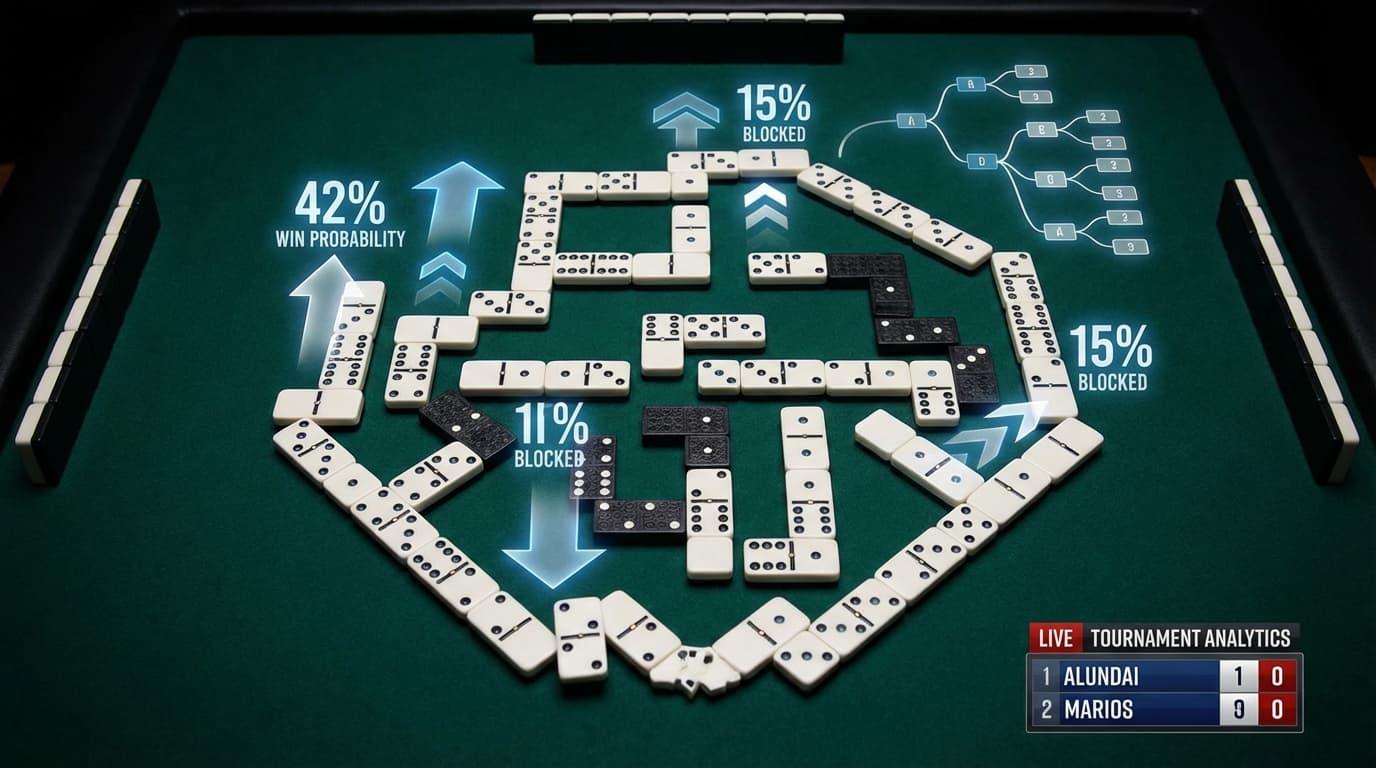
The difference between a good domino player and a great one isn't luck—it's systematic thinking. Tournament champions approach each hand with frameworks that casual players never develop.
These five strategies form the foundation of competitive play. Master them, and you'll beat people you used to lose to.
1. Tile Counting: The Foundation You're Probably Skipping
Every standard domino set contains 28 tiles following the formula (n+1)(n+2)/2, where n is the highest number. In Double-6 (the most common set), that's 28 tiles. In a four-player game, each player holds 7. Do the math.
What this means: When you see a tile played, you're not watching the game unfold—you're updating a mental database. At later stages of the game, with a smaller boneyard, you can easily make informed decisions about probability.
Strong players track which tiles remain in opponents' hands with 80%+ accuracy by mid-game. Most casual players track nothing.
How to practice: After each game, recall the order tiles were played. Start with tracking one number (all the 6s), then expand. Within weeks, tracking becomes automatic.
Tournament application: DCS matches are timed. Players who spend mental energy on basic counting can't allocate resources to higher-level strategy. Build the foundation so it runs in the background.
2. Board Control: Limiting Opponent Options
The board isn't just where tiles go—it's territory you're fighting for.
The key insight: You're not playing your best tile. You're playing the tile that leaves multiple options open for yourself while forcing opponents into corners.
Watch for these patterns:
- Playing a tile that matches something you hold multiple of (giving you future options)
- Forcing endpoints that opponents have been avoiding (they're probably out)
- Holding spinners for maximum impact rather than playing them early
The trap most players fall into: Playing strongest tiles immediately. Short-term advantage, long-term disadvantage. The first tile you play should set up your second through seventh.
Blocking the board means playing tiles that make all hook ends the same number—or numbers you know your opponent isn't holding. If they can't play, they draw. If the boneyard is empty, they pass. Either way, you win.
3. Reading Opponents: The Silent Language
In Caribbean and Latin American traditions, partners communicate through specific plays. In competitive solo play, opponents reveal information constantly—most players just don't notice.
What hesitation means: A pause before playing often indicates multiple options. The tile they eventually choose tells you what else they might hold.
Tracking avoidance patterns: When a player passes on an endpoint they could likely play, that number is probably dead in their hand. When they draw from the boneyard instead of playing an obvious tile, they're avoiding something.
Body language (in person) and timing (online): Some players reveal strength through confidence. Others reveal weakness through delay. At DCS online tournaments, pay attention to response times—they tell you more than players realize.
4. Endgame Calculation: When Math Beats Intuition
The first half of a game involves reading incomplete information. The final tiles are pure calculation.
By the endgame, you should know:
- Which tiles remain in play (tile counting pays off here)
- Which tiles each player likely holds
- The sequence of forced plays that will unfold
Advanced AI analysis of dominoes uses Bayesian inference to calculate precise probabilities from known tiles. You don't need to be a computer, but you need to think systematically.
Counting pip values: In many formats, the game ends when one player dominoes or when the board is blocked. Pip counting determines margin of victory. Strong players track running pip totals throughout, not just at the end.
Setting up the domino: The goal isn't just to go out—it's to go out in a way that maximizes point differential. Sometimes holding a tile back to force an opponent into playing their high-pip bones is worth more than an early finish.
5. Adaptability: Ego Kills Your Ranking
Your starting hand dictates your opening approach. But by the third or fourth play, the game has shifted. The players who rank highest are those who recognize when their initial plan has failed and pivot immediately.
Signals that demand adaptation:
- An opponent unexpectedly passes (your read was wrong—update it)
- The boneyard is depleted earlier than expected (adjust endgame calculations)
- A key tile you were counting on gets played against you
The mental discipline: Don't fall in love with your plan. Fall in love with winning.
Stop Reading. Start Proving.
You can study strategy all day. But until you're staring at a leaderboard that says you're ranked #47 in your city while some player you've never heard of sits at #3, theory means nothing.
DCS online tournaments run weekly across 50+ city chapters. Every game is ranked. Every opponent wants your spot. And the leaderboard doesn't care how many articles you've read.
Your ranking will tell you exactly how good these strategies made you. Or exactly how much work you still need to do.
Sources and Further Reading
- The Mathematics of Dominoes — Pagat (comprehensive domino mathematics reference)
- The Science of Mexican Train Dominoes: Math and Probability — Mexican Train Dominoes
- Dominoes Strategy: How to Master the Game — Cool Math Games
- Dominoes Scoring Strategy — HowStuffWorks
- Dominos Game Strategy & AI Simulation — ReelMind AI
- Mathematics of Dominoes: Probability and Combinations — Playiro