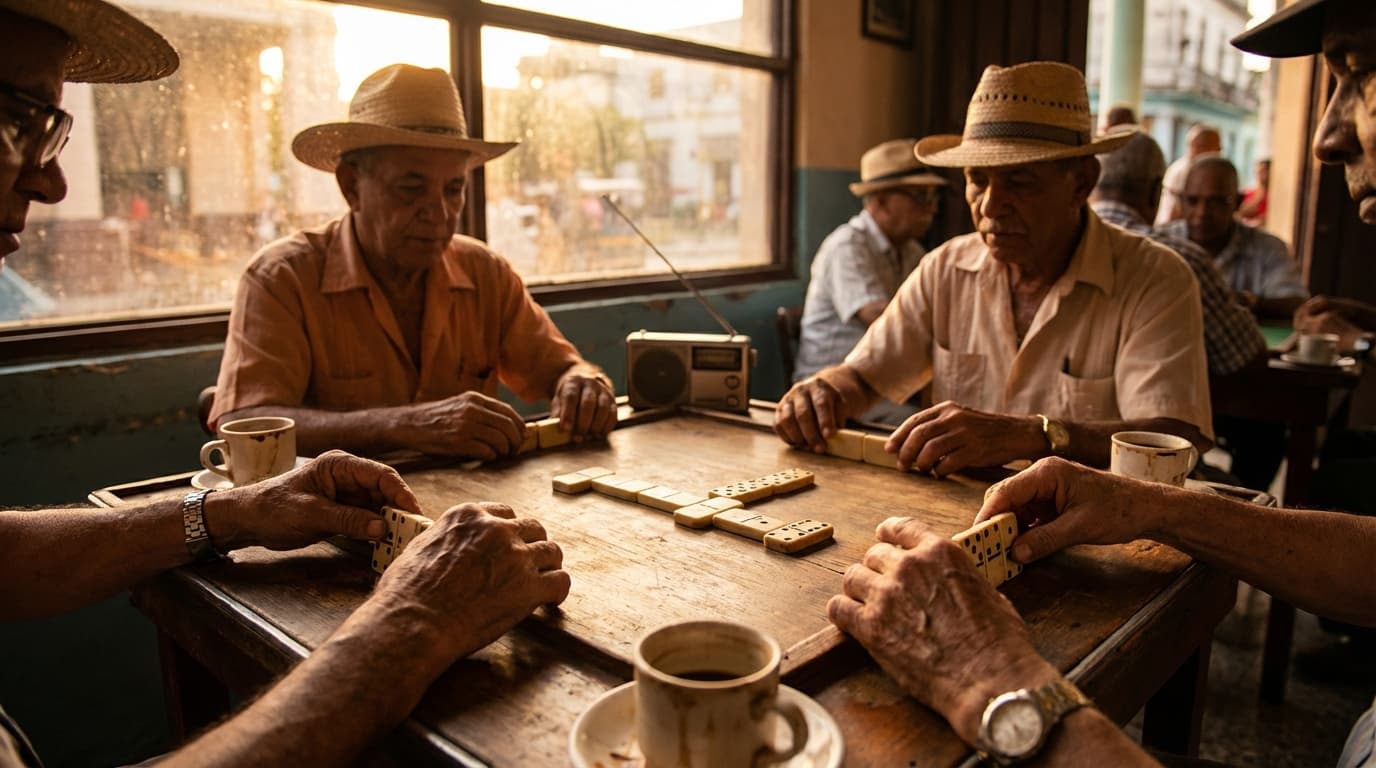
Walk through any Caribbean neighborhood on a Saturday afternoon, and you'll find them: folding tables set up on sidewalks, tiles clacking against wood, voices rising with each play. The game ends. Someone immediately reshuffles.
This isn't just entertainment. It's culture.
The Caribbean: Where Dominoes Is a Way of Life
In Puerto Rico, "El Domino" isn't simply a game of strategy—it's an activity around which community relationships are built and sustained. Dominoes are played across all social classes by people of all ages. Children learn from fathers, uncles, and grandfathers. The knowledge passes down like any other family tradition.
The rules themselves reflect the culture. Puerto Rican dominoes plays counter-clockwise (to the right) due to Spanish origins, and traditionally, the player with the most points after seven hands buys everyone a beer. Losing has consequences beyond the scoreboard.
Cuban dominoes developed its own flavor—faster play, Double-9 sets instead of Double-6, and deeper integration into neighborhood social fabric from Havana to Miami. The Dominican Republic shares close cultural ties with Puerto Rico, and dominoes serves as common ground across the Greater Antilles.
The Barbershop: Sanctuary and Proving Ground
In African American communities, the barbershop has been one of the few spaces where Black people could be vulnerable and talk about issues of importance. The Smithsonian's National Museum of African American History and Culture documents how these establishments joined Black churches and the Black press as spaces for the public sphere of Black life.
Dominoes fit naturally. According to scholars cited by the National Association of Barbers, Black barbershops were spaces where men "played endless hours of chess, bid whist, and dominoes, while chopping it up about local politics and community affairs."
The combination worked: a game that rewards patience, observation, and reading opponents, played in a space that served as "therapy sessions, news centers, and family reunions". The verbal sparring—the trash talk—developed here and remains a core part of competitive domino culture today.
This heritage matters. Black barbershops produced Alonzo Herndon, one of America's first Black millionaires, who started with a single shop. The entrepreneurial spirit and community bonds forged in these spaces shaped generations.
Family Tables and Multi-Generational Knowledge
In Mexican and Central American communities, dominoes anchored family gatherings. Grandparents played with grandchildren. Cousins formed rivalries that lasted decades. The game bridged generations who might otherwise have little common ground.
Strategies passed from generation to generation, refined but recognizable across decades. A player today might still use an opening their grandmother taught them in 1970—because it still works.
What These Traditions Share
Across cultures, domino traditions share common elements:
The table as neutral ground: Political disagreements, family feuds, professional rivalries—all suspended during play. The table was where people who might not otherwise interact came together.
Memory as currency: Communities that valued oral tradition found dominoes the perfect fit. The game rewards those who remember: past plays, opponent tendencies, historical matches.
Competition without destruction: Unlike many competitive spaces, losing at dominoes means you play again tomorrow. Rivalries motivate improvement rather than create permanent division.
Gathering as purpose: "Going to play dominoes" was a complete reason to leave the house, one that families accepted because they understood its importance.
From Local Legend to National Ranking
For most of its history, dominoes competition was purely local. You knew who the best player in your neighborhood was. Maybe you'd heard rumors about someone in another city. But there was no way to settle it.
That's what DCS changes.
The same player who dominated barbershop games in Chicago can now prove it against the plaza veteran from Miami. Family-taught strategy meets tournament-tested tactics. Online play means no travel, no excuses—just you, your opponent, and the tiles.
When your city faces another in a Sister Cities Championship, you're carrying more than your own reputation. You're representing a tradition.
We Don't Mandate How You Play
DCS respects the diversity of domino traditions:
Play styles vary: The fast-paced Caribbean approach, the methodical family-taught style, the psychological warfare of barbershop veterans—all have a place. Your tradition isn't wrong. It's tested.
The atmosphere matters: Our online platform includes the community elements that make dominoes what it is. Tournaments aren't sterile—they're competitive, yes, but the culture travels with the game.
Generational bridges: DCS brings together players who learned from YouTube alongside players who learned from their grandfather. Both have something to teach. Both have something to prove.
Sources and Further Reading
- The Community Roles of the Barber Shop and Beauty Salon — Smithsonian National Museum of African American History and Culture
- The Rules of Puerto Rican Dominoes — Caribbean Trading
- All About Dominoes in the Caribbean — Caribbean Trading
- The History of Black Barbershops — National Association of Barbers
- Down to the Roots: The History and Tradition of the Black Barbershop — The Rich Barber
- Dominican Republic Daily Life and Culture — Britannica
Represent your city—enter a tournament and add your chapter to the story.